


How practical controls strengthen reporting and support better decisions
Many business owners hear the phrase “internal controls” and immediately think of large corporations, public companies, audits, or complicated compliance requirements.
But internal controls are not just for big companies.
For growing businesses, internal controls are practical tools that help protect the organization, improve accountability, support reliable reporting, and make growth easier to manage. As a company expands, more people, systems, vendors, customers, and transactions become part of daily operations. What once worked informally may no longer be enough.
A small business may be able to rely on trust, habit, and a few key people in the early stages. But as the business grows, informal processes can create blind spots. Payments may be approved without enough review. Financial reports may take longer to prepare. System access may not be clearly managed. Important steps may depend too heavily on one person.
That is where internal controls become important.
What Are Internal Controls?
Internal controls are the policies, processes, assigned responsibilities, and routine checks built into a company’s day-to-day operations to help it achieve its objectives, safeguard its assets, produce reliable financial and operational information, comply with applicable requirements, and prevent or detect errors, fraud, and other risks.
Simply put, internal controls are the practical guardrails that help a business operate consistently, responsibly, and with greater confidence.
Examples of internal controls may include:
- Reviewing bank reconciliations
- Requiring approval before vendor payments are made
- Limiting access to accounting systems
- Separating incompatible responsibilities, where practical
- Documenting key financial procedures
- Reviewing financial reports before they are shared
- Keeping records of approvals and supporting documentation
For smaller businesses, fully separating responsibilities may not always be practical because of limited staffing. In those situations, management can use compensating controls, such as owner review of bank activity, additional approval for significant payments, automated system alerts, approval limits, or periodic independent reviews, to reduce risk without creating unnecessary bureaucracy.
In simple terms, internal controls help answer important questions:
Who is responsible?
Who approves?
Who reviews?
Is the supporting documentation complete and accessible?
Can the business trust the numbers?
When those answers are clear, the business is in a stronger position to manage growth.
Why Growing Businesses Need Controls Earlier Than They Think

Many companies wait too long to strengthen internal controls. They often do not realize there is a problem until something exposes the gap.
That may happen during an audit, lender review, investor request, grant review, due diligence process, or even an internal leadership meeting where the numbers do not feel reliable.
Growth creates complexity. A larger team may mean more people involved in approvals, expenses, payroll, reporting, purchasing, and financial decisions. More transactions can mean more opportunities for errors, delays, or missed steps. More systems can create confusion over access, ownership, and responsibility.
Signs Your Controls May Not Be Keeping Pace
Some early warning signs may include:
- Financial reports that are delayed, frequently corrected, or difficult to explain
- Approvals occurring through undocumented emails or verbal conversations
- One person initiating, approving, recording, and reconciling the same transactions
- Employees retaining system access that is no longer appropriate for their responsibilities
- Important reconciliations or reporting activities depending entirely on one individual
- Difficulty locating supporting documentation when an auditor, lender, investor, or manager requests it
These warning signs often indicate that processes that worked when the company was smaller may no longer be strong enough for its next stage of growth.
Internal controls should grow with the business. They do not need to be overly complicated, but they do need to be intentional.
Common Areas Where Controls Matter
Internal controls can support many parts of a business, especially areas tied to money, reporting, approvals, and accountability.
Some common areas include:
Cash and Bank Accounts
Cash is one of the most important areas to protect. Controls around bank reconciliations, deposits, transfers, and account access help reduce errors and improve visibility.
Vendor Payments
Vendor payments should have clear approval steps, proper documentation, and review before payment is issued. This helps reduce duplicate payments, unauthorized purchases, and confusion.
Payroll Changes
Payroll is another sensitive area. Changes to pay rates, employee records, bonuses, and terminations should be reviewed and approved before processing.
Expense Approvals
Expense policies and approval workflows help employees understand what is allowed, who approves it, and what documentation is required.
System Access
Not every employee needs access to every financial system or function. Clear access controls help protect sensitive information and reduce unnecessary risk.
Financial Reporting
Reports should be reviewed for accuracy and consistency before leadership relies on them. Strong reporting controls help decision-makers trust the information they receive.
Month-End Close
A clear month-end close process helps ensure accounts are reviewed, reconciliations are completed, and financial information is prepared on time.
Internal Controls Support Better Decision-Making
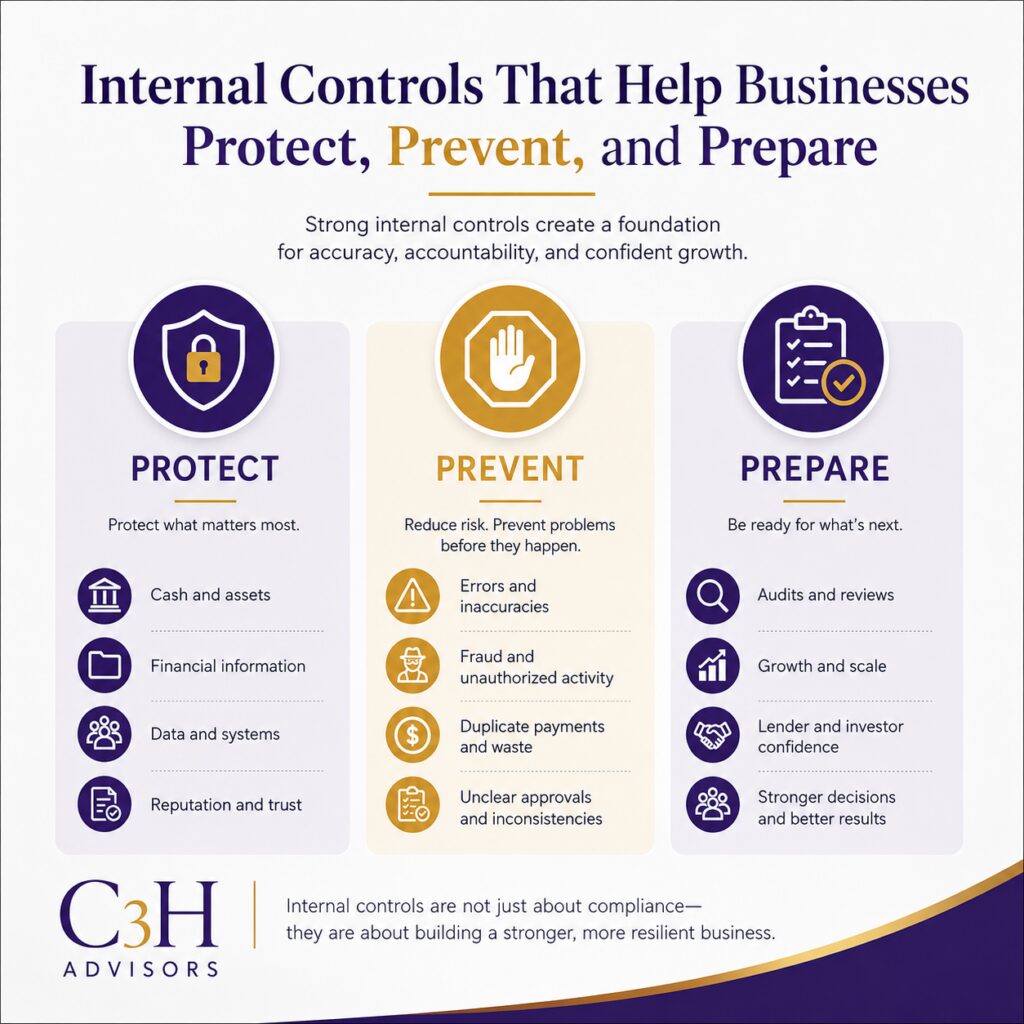
Internal controls are often discussed in terms of risk, compliance, or audit preparation. Those are important, but they are not the whole story.
Strong controls also support better business decisions.
When financial reports are prepared using consistent processes, reviewed carefully, and supported by reliable documentation, leadership can have more confidence in the numbers. Instead of questioning whether the information is accurate, leaders can focus on what the information means.
That matters for pricing decisions, hiring plans, cash flow management, financing conversations, expansion opportunities, and long-term strategy.
A business cannot make confident decisions with unclear information. Internal controls help create the structure behind reliable financial insight.
Strong Controls Support Audit Readiness
Internal controls also play an important role in audit readiness.
A business with clear controls is usually better prepared to respond to outside requests because it already has organized records, approval trails, completed reconciliations, review procedures, and documented processes.
This can reduce last-minute stress when an auditor, lender, investor, or other outside party asks for support.
Audit readiness should not begin when the request arrives. It should be supported by the way the business operates throughout the year.
Controls Should Be Practical, Not Overwhelming
Internal controls do not need to bury a business in paperwork. The goal is not to create unnecessary complexity.
The goal is to design controls that match the size, structure, and needs of the organization.
For a growing business, that may begin with simple improvements:
- Documenting key procedures
- Clarifying approval responsibilities
- Reviewing system access
- Strengthening reconciliations
- Creating better reporting review steps
- Reducing excessive dependence on one individual
- Organizing support for important transactions
Small changes can make a meaningful difference when they are practical and consistently followed.
How C3H Advisors Helps
C3H Advisors helps growing businesses assess how their key processes currently operate, identify control gaps, clarify responsibilities, document critical procedures, and implement practical improvements appropriate for their size and complexity.
If your business has outgrown informal approvals, undocumented processes, or financial reporting that depends too heavily on one person, it may be time to evaluate whether your controls are keeping pace with your growth.

Schedule a consultation at www.C3Hadvisors.com.
Disclaimer
This article is for general educational purposes only and should not be considered accounting, tax, legal, or regulatory advice. Businesses should consult with a qualified professional regarding their specific circumstances.